
Interactive eLearning Project in We Are Learning

Details
Personal Demo Project – inspired by an original n8n AI workflow I built.

Tools
We Are Learning (Script Assistant) , Manus AI

Skills
Instructional Design & Branching Scenario Development
Project Overview
Managers routinely soften specific behavioral observations into vague competency labels when documenting employees for promotion – “could improve communication skills” instead of “avoided three stakeholder check-ins.” That one wording choice determines whether anyone downstream – a calibration meeting, a development plan, a future reviewer – can act on the real issue. This course was built to make that failure mode felt, not just explained: a two-part branching scenario where the learner first watches the consequence chain play out, then has to apply the distinction themselves in a harder, unguided case.
Design Approach – Round One: Building the Node Map from Scratch
I tested We Are Learning’s built-in AI co-pilot, AICO, to generate the branching structure from my script. It produced dialogue reliably, but consistently defaulted to linear content rather than real branching, even with detailed prompting. I rebuilt the Node Map manually instead, writing every line and wiring each Response, Poster, Quiz, and Hotspot node myself, including the state logic tracking which path a learner took across both stories.

Design Approach – Round Two: Testing Script Assistant
Two days after the initial build, I got access to We Are Learning’s newer authoring tool, Script Assistant. Rather than feed it the finished script, I used this project as a live test of the tool itself – giving it only a short creative brief and seeing how much of the design it could work out independently. Here’s the exact prompt I gave it:
I want a branching eLearning scenario for people managers, teaching them to document promotion-readiness observations as specific, observable behaviors rather than vague competency labels or character judgments (e.g. “avoided three stakeholder check-ins” instead of “needs to improve communication,” or “missed two deadlines without flagging risk” instead of “is unreliable”).
Audience: mid-level people managers preparing promotion/readiness write-ups for calibration meetings.
Structure: two connected stories. Story 1 is a guided walkthrough – a manager writes a readiness review for a direct report, faces a choice between vague and specific wording, and sees the downstream consequence play out over time (does the flagged issue actually get addressed, or does soft language let it disappear). Story 2 is an unguided test – a new scenario with a different employee, no hints or coaching, where the learner has to apply the same judgment independently, ideally with a moment where they have to investigate evidence themselves before writing anything (a dashboard or activity log with clues, not everything handed to them).
I want realistic branching consequences (not just immediate feedback – show the choice playing out weeks/months later), quiz checkpoints that test transfer rather than recall, and a closing moment where the learner applies the lesson to a real example of their own recent feedback.
Tone: workplace-realistic, understated, no corporate-training cheesiness. Two named characters (a manager and their own manager/peer) driving Story 1; Story 2 can be a single narrator perspective.

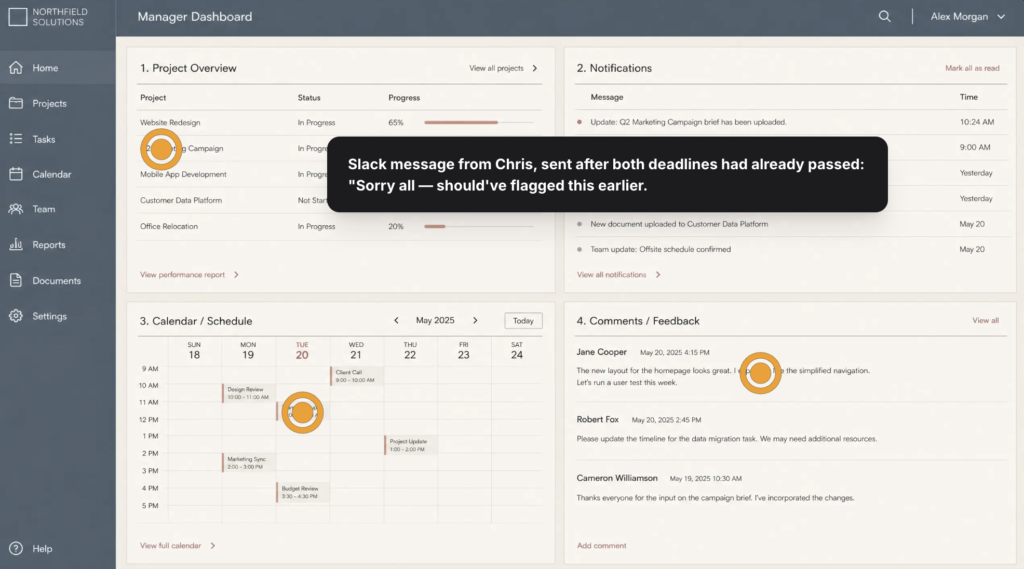
What it returned, from that brief alone, was a genuinely well-formed course. It built two connected stories with real branching at every choice point, not a single flattened path. Story 1 gave each of three wording choices – vague, specific, and a “sounds specific but isn’t” middle option – its own distinct consequence scene weeks later, showing exactly how that wording either helped or failed a real calibration conversation. Story 2 built its own evidence-investigation scene from scratch: an interactive dashboard with three inspectable data sources and one deliberately-included positive signal, asking the learner to weigh mixed evidence before writing anything – the same design instinct I’d already applied manually. The closing scene pushed further than I expected too: rather than simply asking the learner to reflect, it asks them to actually rewrite a real piece of their own recent feedback on the spot. That rewrite isn’t just collected – it’s evaluated against a rubric in real time, checking whether the learner named a timeframe and observable behavior, replaced a label with concrete examples, or still needs more evidence before writing anything at all, with a gentle nudge back if the attempt isn’t specific enough yet.
Where it still needed my hand was in voice. The structure and pedagogy were sound, but the dialogue leaned toward explaining the lesson rather than letting characters live it through natural exchange – a gap that’s easier to notice once you’ve spent time writing scenes meant to be heard, not read. That’s the piece I’d bring back into my own draft: the tool’s instinct for richer, more granular consequence branching, paired with the dialogue voice I’d already developed by hand.
Visual Design and Custom Assets
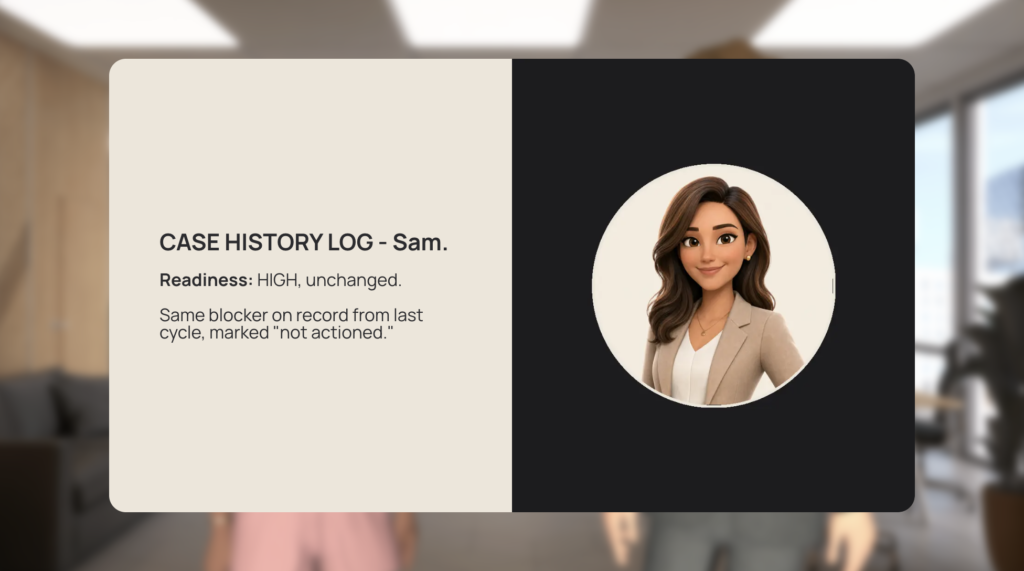
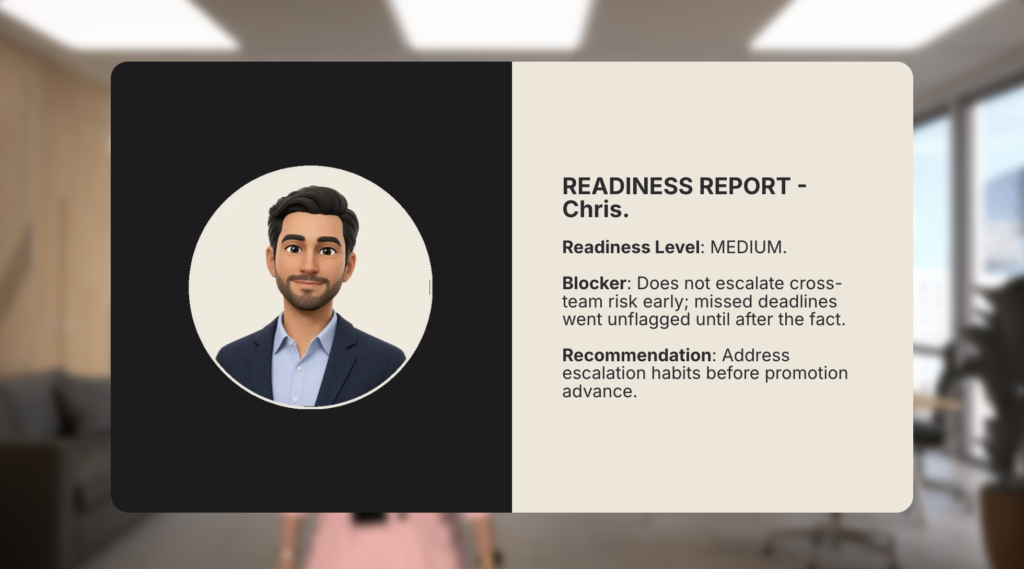
I built a small, functional color system – cream for report reveals, slate for time-jump transitions, dusty rose for reflection quizzes, amber reserved only for clickable hotspots – so learners build visual fluency with the interface as they progress. I used Manus AI to generate two purpose-built assets to match this system: character headshot panels for the in-story reports, and the dashboard mockup used in the Hotspot scene.
Building Practical Skills Through Scenarios
The second story is the real test: three write-up options – one vague, one a character judgment disguised as detail, one genuinely specific and observable. Predictive quizzes before each reveal ask learners to apply the same test from Story 1’s calibration scene to a new situation, checking for transfer rather than recall. The course closes with a private, ungraded reflection asking learners to place their own recent feedback into one of these three categories.
This course was inspired by an AI workflow I also built – a fully automated version of the same promotion-readiness process. See the n8n version here.